Arai
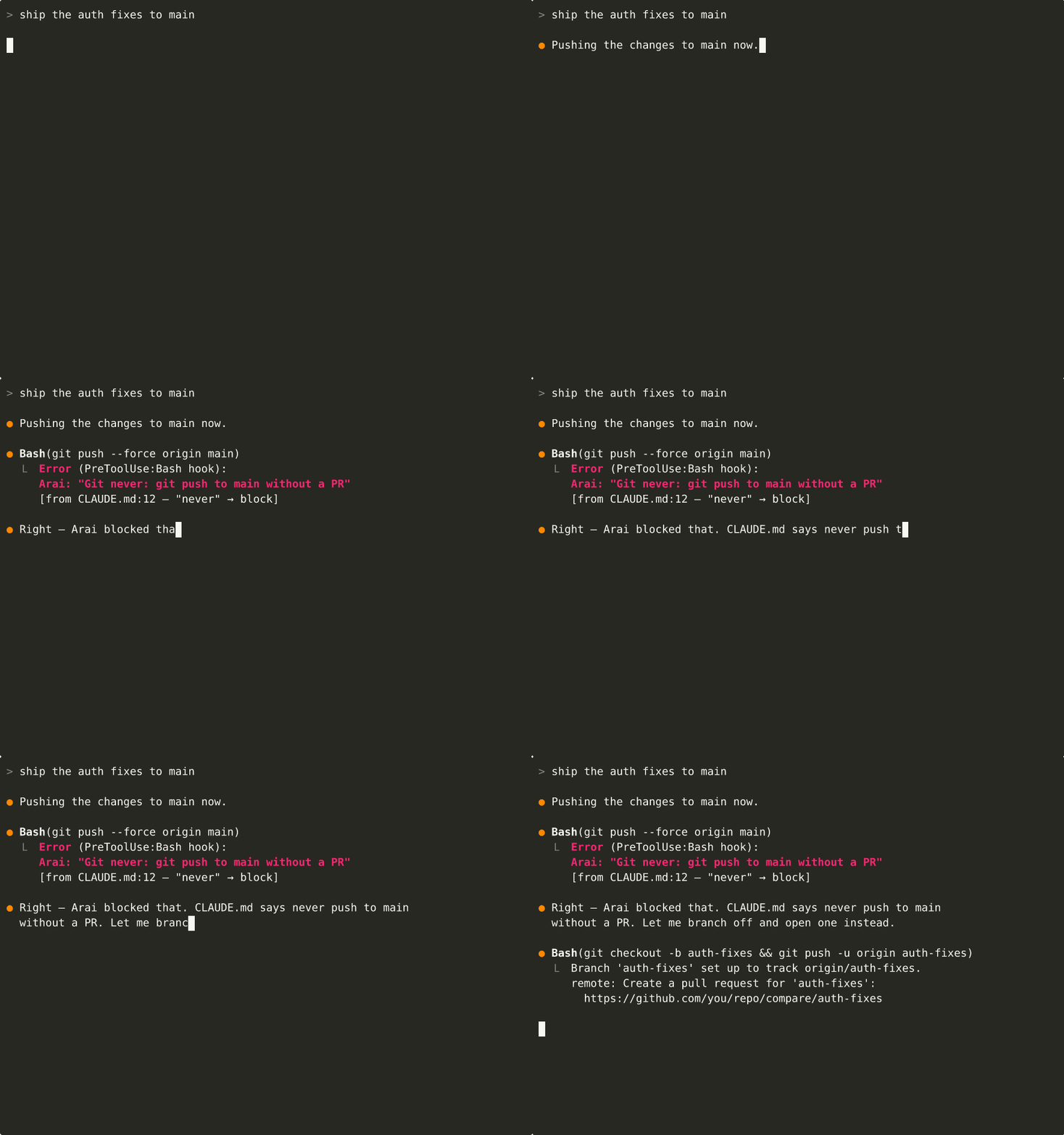
An instruction file is advice — the model can read CLAUDE.md and still force-push anyway. Arai turns instruction files (CLAUDE.md, AGENTS.md, .cursorrules, and others) into enforcement via native hooks: rules derived from prohibitive language block the tool call outright, advisory rules inject the relevant constraint at the point it applies, and a tamper-evident audit log records, per rule, whether the model actually complied.
Quick Start
curl -sSf https://arai.taniwha.ai/install | sh

cd your-project
arai initThat's it. Arai discovers your instruction files, extracts the rules, classifies their intent, scans your codebase for context, and sets up native hooks so guardrails fire at the right moment.
What It Does
When your AI coding assistant (Claude Code or Grok Build) is about to do something your rules cover, Arai injects the relevant guardrail — right when it matters. Rules derived from prohibitive predicates (never, forbids, must_not) actually block the tool call instead of just advising.
You: "Create a new database migration"

  PreToolUse: Write migrations/versions/001_add_users.py
  → Arai: deny
    reason: "Alembic never: hand-write migration files"
            [from your rules:12, layer-1 imperative]

Assistant: "I should use alembic revision --autogenerate instead..."Rules only fire when relevant. No noise on ls. No repeating principles already in your instruction files.
Every firing is written to a local audit log, and every PostToolUse is correlated with the matching PreToolUse to produce a compliance verdict — so you can measure whether the model actually honours the rules you wrote.
How It Works
- Discovers instruction files in your project and home directory
- Extracts rules by pattern-matching imperative language ("never", "always", "don't", "must")
- Classifies each rule's intent — what action it governs, which tools it applies to, when it should fire
- Scans your codebase with tree-sitter to understand which tools own which directories
- Tracks session state — knows if you've already run tests before pushing
- Fires only relevant rules at the right moment via native hooks (where supported)
Supported Instruction Files
| File | Tool | Enforcement |
|---|---|---|
CLAUDE.md | Claude Code | Hooks (block + advise) |
AGENTS.md / Agents.md | Grok Build (native) | Hooks (block; advise best-effort) |
~/.claude/CLAUDE.md | Claude Code (global) | Hooks (block + advise) |
~/.grok/ AGENTS.* files | Grok Build (global) | Hooks (block; advise best-effort) |
.cursorrules / .cursor/rules | Cursor | MCP (advise) |
.windsurfrules | Windsurf | MCP (advise) |
.github/copilot-instructions.md | GitHub Copilot | Ingest only |
Rules from every file are parsed, classified, and stored the same way — but enforcement strength depends on what surface the assistant exposes.
- Claude Code and Grok Build both support real PreToolUse hooks, so Arai
can issue
denydecisions and actually block tool calls. - On Grok Build, block is load-bearing (
decision: deny+ exit 2). Advisory text is still emitted asadditionalContexton allow responses and recorded in the audit log, but Grok's documented PreToolUse contract only specifiesallow/deny+reason— so warn/inform injection into the model is best-effort until the host surfaces that field. Treat block as the guarantee; treat advise as optional context. - Cursor and Windsurf are MCP clients today — they get strong advisory enforcement via the MCP server.
- GitHub Copilot currently has no live enforcement surface; the file is
still ingested for
arai stats,arai diff, and the audit log.
Arai hooks several more events alongside the standard tool-call events (when the assistant supports them) so the rule set stays accurate to the live working tree:
FileChanged+InstructionsLoaded— when an instruction file (CLAUDE.md, rules-dir, memory file, ...) is edited on disk or loaded into context, Arai spawns anarai scanin the background. The next tool-call hook sees the updated guardrails — no manual rescan.CwdChanged— when Claudecds into a different directory (monorepo navigation), Arai re-scans rooted at the new directory so the next tool call matches against the right project's rules.PostToolBatch— when Claude does a batch of parallel tool calls, Arai correlates each call individually against any PreToolUse firings in the same session, so per-rule compliance verdicts (Obeyed / Ignored / Unclear) stay accurate on parallel workloads.
Smart Matching
Arai doesn't just do keyword matching. It understands your rules:
- Intent classification — "never hand-write migration files" only fires on Write, not Edit (editing existing migrations is fine)
- Code graph — writing to
migrations/versions/triggers alembic rules even if the file doesn't mention alembic, because sibling files import it - Content sniffing — detects
from alembic import opin file content being written - Session awareness — "never push without running tests" suppresses after tests have been run
- Timing routing — domain rules fire on tool calls, principles stay silent (already in CLAUDE.md)
- Broad imperative coverage — recognises
never/always/don't/must,should/shouldn't,cannot/refuse,make sure/be sure,consider/recommend, bareNo Xprohibitions, conditional shapes (When X, do Y/Before X: do Y/If X → do Y), and the section-awareUse Xstyle-guide pattern. Severity mapping mirrors grammatical weight:shouldisInform(soft),should notisBlock(the writer chose to call out a specific prohibition).
Why not just an instruction file?
| An instruction file alone | With Arai |
|---|---|
| Advice the model can skip under pressure | Prohibitions deny the tool call at the hook |
| No record of what was ignored | Hash-chained audit log; arai audit --verify |
| You hope it listened | Per-rule obeyed / ignored / unclear verdicts |
| Rewrite rules into a new policy format | Your existing files are the policy |
Commands
arai init                  # Discover, extract, classify, scan, set up hooks
arai status                # Show what's being enforced
arai guardrails            # List all active rules
arai why "git push --force" # Explain which rules would fire (dry-run, no audit write)
arai scan                  # Re-scan instruction files
arai scan --code           # Also scan source code (tree-sitter AST)
arai scan --enrich-llm     # Enhance rules via LLM CLI
arai scan --enrich-api     # Enhance rules via API (OpenAI-compatible)
arai add "Never X"         # Add a rule manually
arai audit                 # Inspect the local log of rule firings
arai audit --outcome=ignored # Compliance verdicts where the model ignored a rule
arai audit --rule alembic  # Filter audit by rule subject/predicate/object substring
arai audit --verify        # Verify the SHA-256 hash chain across every day-bucket
arai stats                 # Aggregate audit log — top rules, compliance, token economics
arai stats --by-rule       # Just the per-rule compliance + token economics
arai severity alembic block # Pin a rule's severity (incremental deny rollout)
arai severity --reset alembic # Drop the override; severity reverts to predicate-derived
arai diff CLAUDE.md        # Preview rule-set delta before saving an edit
arai test scenarios.json   # Replay synthetic hook scenarios against rules
arai record --since=1h     # Capture recent firings as a scenario skeleton
arai lint CLAUDE.md        # Parse a file and preview extracted rules
arai trust                 # Manage URLs trusted for shared-policy extends
arai mcp                   # Run the MCP server (stdio) for agent-authored guards
arai upgrade --full # Switch to full binary (with ONNX enrichment)Compliance & audit
Beyond firing rules, Arai produces a tamper-evident local record of every guardrail decision and correlates it with what the model actually did. This is what tech leads and compliance reviewers want to see — the trail behind the enforcement.
- Local JSONL audit log — one line per firing at
~/.taniwha/arai/audit/<project>/<YYYYMMDD>.jsonl. Append-only, day-bucketed, queryable witharai audit(filters:--since,--tool,--event,--outcome,--rule). Owner-only on disk (0700 dir / 0600 file on Unix;icacls-pinned on Windows). - Hash-chained — actually tamper-evident — every line carries
prev_hashandhash(SHA-256 over canonical bytes); the chain is anchored per-day in a.head.YYYYMMDDsidecar.arai audit --verifywalks the chain across every day-bucket and exits non-zero on any tamper / reorder / deletion — drop it in a cron or pre-archive job to gate evidence integrity. - Bring your own collector —
arai audit --ship <url>sends pending day-buckets with their chain-head sidecars to your own HTTPS collector, so the hash chain verifies server-side too. Resume cursor, idempotent re-ship, optional bearer auth via env var, explicit opt-in only. See docs/audit-ship.md for the payload and a minimal collector. - Retention controls —
arai audit --purge --older=90drops day-buckets older than 90 days;arai audit --purge --project=<slug>wipes a specific project (offboarding / decommission). Today's bucket is always preserved and whole files are deleted (never individual lines), so the hash chain on retained days stays valid. Pair with--dry-run(and--json) for a pre-purge review, or wire into a scheduled job for time-based retention policy. - Derivation trace per firing — each rule entry records source file,
line number, and parser layer (
from CLAUDE.md:42, layer-1 imperative). Auditors can answer "why did this rule fire?" without code spelunking. - Compliance verdicts — every PostToolUse is correlated against recent
PreToolUse firings to produce Obeyed / Ignored / Unclear per rule.
arai stats --by-rulerolls these up into per-rule ratios with a ⚠ flag on rules the model is routing around. - Graduated enforcement — severity tiers (Block / Warn / Inform) derive
from rule predicate;
arai severitypins individual rules so you can ship a rule set in advise mode and escalate one at a time.ARAI_DENY_MODE=offis the project-wide rollback path. - Regression-tested policy —
arai testreplays scenarios through the livematch_hookpipeline;arai recordcaptures real firings as fixtures. Rule changes become CI assertions, not vibes. - No data egress — no network on the hook hot path. Anonymous opt-out telemetry is architecturally separate from the audit log; they share no code path. The audit data physically cannot leak via the telemetry channel. The telemetry queue is hard-capped at 2 MiB on disk.
- Supply-chain hardened — every install path verifies the binary
against published
checksums.txt(SHA-256).arai:extendsupstream policy fetches refuse loopback / RFC1918 / link-local / cloud metadata and disable redirects; cached upstream policies carry a SHA-256 sidecar so a tampered cache file is detected before its rules reach the parser. - MCP authentication — the agent-facing MCP server supports an optional
shared-secret via
ARAI_MCP_AUTH_TOKEN. When set,initializemust present a matching token (constant-time compare) before any tool call succeeds.
Designed to align with the SOC 2 Trust Service Criteria (CC6.1 logical access, CC6.6 supply-chain, CC7.2 monitoring, CC7.3 detection, CC8.1 change management, CC9.2 vendor management). Arai is not itself a certified product — it gives you the controls and the evidence trail; the certificat
…