MCP Server for ZenML
This project implements a Model Context Protocol (MCP) server for interacting with the ZenML API.
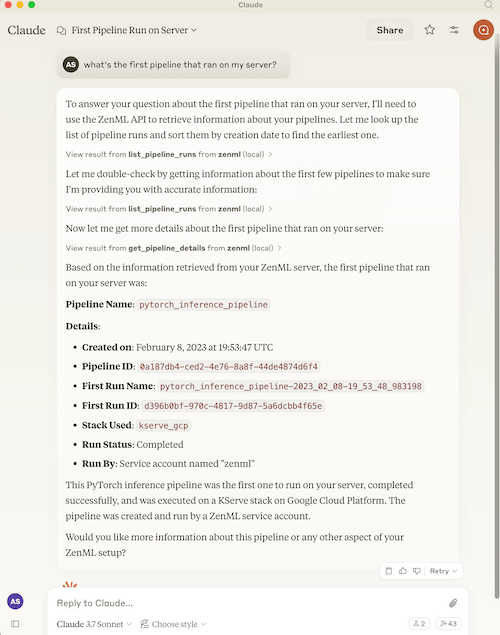
What is MCP?
The Model Context Protocol (MCP) is an open protocol that standardizes how applications provide context to Large Language Models (LLMs). It acts like a "USB-C port for AI applications" - providing a standardized way to connect AI models to different data sources and tools.
MCP follows a client-server architecture where:
- MCP Hosts: Programs like Claude Desktop or IDEs that want to access data through MCP
- MCP Clients: Protocol clients that maintain 1:1 connections with servers
- MCP Servers: Lightweight programs that expose specific capabilities through the standardized protocol
- Local Data Sources: Your computer's files, databases, and services that MCP servers can securely access
- Remote Services: External systems available over the internet that MCP servers can connect to
What is ZenML?
ZenML is an open-source platform for building and managing ML and AI pipelines. It provides a unified interface for managing data, models, and experiments.
For more information, see the ZenML website and our documentation.
Features
The server provides MCP tools to access core read functionality from the ZenML server, providing a way to get live information about:
Core Entities
- Users - user accounts and permissions
- Stacks - infrastructure configurations
- Stack Components - individual stack building blocks
- Flavors - available component types
- Service Connectors - cloud authentication
Pipeline Execution
- Pipelines - pipeline definitions
- Pipeline Runs - execution history and status
- Pipeline Steps - individual step details, code, and logs
- Schedules - automated run schedules
- Artifacts - metadata about data artifacts (not the data itself)
Deployment & Serving
- Snapshots - frozen pipeline configurations (the "what to run/serve" artifact)
- Deployments - runtime serving instances with status, URL, and logs
- Services - model serving endpoints
Organization & Discovery
- Projects - organizational containers for ZenML resources
- Tags - cross-cutting metadata labels for discovery
- Builds - pipeline build artifacts with image and code info
Models
- Models - ML model registry entries
- Model Versions - versioned model artifacts
Deprecated (migration recommended)
Pipeline run templates→ use Snapshots instead (see Migration Guide)
The server also allows you to trigger new pipeline runs using snapshots (preferred) or run templates (deprecated).
Note: We're continuously improving this integration based on user feedback. Please join our Slack community to share your experience and help us make it even better!
Available Tools
The MCP server exposes the following tools, grouped by category:
Pipeline Execution (New in v1.2)
| Tool | Description |
|---|---|
get_snapshot | Get a frozen pipeline configuration by name/ID |
list_snapshots | List snapshots with filters (runnable, deployable, deployed, tag) |
get_deployment | Get a deployment's runtime status and URL |
list_deployments | List deployments with filters (status, pipeline, tag) |
get_deployment_logs | Get bounded logs from a deployment (tail=100 default, max 1000) |
trigger_pipeline | Trigger a pipeline run (prefer snapshot_name_or_id parameter) |
Organization (New in v1.2)
| Tool | Description |
|---|---|
get_active_project | Get the currently active project |
get_project | Get project details by name/ID |
list_projects | List all projects |
get_tag | Get tag details (exclusive, colors) |
list_tags | List tags with filters (resource_type) |
get_build | Get build details (image, code embedding) |
list_builds | List builds with filters (is_local, contains_code) |
Core Entities
| Tool | Description |
|---|---|
get_user, list_users, get_active_user | User management |
get_stack, list_stacks | Stack configurations |
get_stack_component, list_stack_components | Stack components |
get_flavor, list_flavors | Component flavors |
get_service_connector, list_service_connectors | Cloud connectors |
get_pipeline_run, list_pipeline_runs | Pipeline runs |
get_run_step, list_run_steps | Step details |
get_step_logs, get_step_code | Step logs and source code |
list_pipelines, get_pipeline_details | Pipeline definitions |
get_schedule, list_schedules | Schedules |
list_artifacts | Artifact metadata |
list_secrets | Secret names (not values) |
get_service, list_services | Model services |
get_model, list_models | Model registry |
get_model_version, list_model_versions | Model versions |
Interactive Apps (Experimental)
| Tool | Description |
|---|---|
open_pipeline_run_dashboard | Open interactive pipeline runs dashboard (MCP App) |
open_run_activity_chart | Open 30-day run activity bar chart (MCP App) |
Analysis Tools
| Tool | Description |
|---|---|
stack_components_analysis | Analyze stack component usage |
recent_runs_analysis | Analyze recent pipeline runs |
most_recent_runs | Get N most recent runs |
Diagnostics
| Tool | Description |
|---|---|
diagnose_zenml_setup | Diagnose server setup (env vars, SDK, connectivity, auth). Works even when misconfigured. |
Deprecated Tools
| Tool | Replacement |
|---|---|
get_run_template | Use get_snapshot instead |
list_run_templates | Use list_snapshots instead |
trigger_pipeline(template_id=...) | Use trigger_pipeline(snapshot_name_or_id=...) |
Migration: Run Templates → Snapshots
Why the change? ZenML evolved its "runnable pipeline artifact" concept. Run Templates are now deprecated wrappers that internally just point to Snapshots. New code should use Snapshots directly.
Quick Migration Guide
| Old Pattern (Templates) | New Pattern (Snapshots) |
|---|---|
list_run_templates() | list_snapshots(runnable=True, named_only=True) |
get_run_template(name) | get_snapshot(name, include_config_schema=True) |
trigger_pipeline(template_id=...) | trigger_pipeline(snapshot_name_or_id=...) |
Example Workflow (Snapshot-First)
1. Discover project context:
   → get_active_project()

2. Find runnable snapshots:
   → list_snapshots(runnable=True, named_only=True)

3. Trigger a run:
   → trigger_pipeline(pipeline_name_or_id="my-pipeline", snapshot_name_or_id="my-snapshot")

4. Check deployments:
   → list_deployments(status="running")
→ get_deployment_logs(name_id_or_prefix="my-deployment", tail=100)Note: get_deployment_logs returns bounded output (default 100 lines, max 1000, capped at 100KB) and requires the appropriate deployer integration to be installed.
Quick Setup via Dashboard (Recommended)
The easiest way to set up the ZenML MCP Server is through your ZenML dashboard's MCP Settings page.
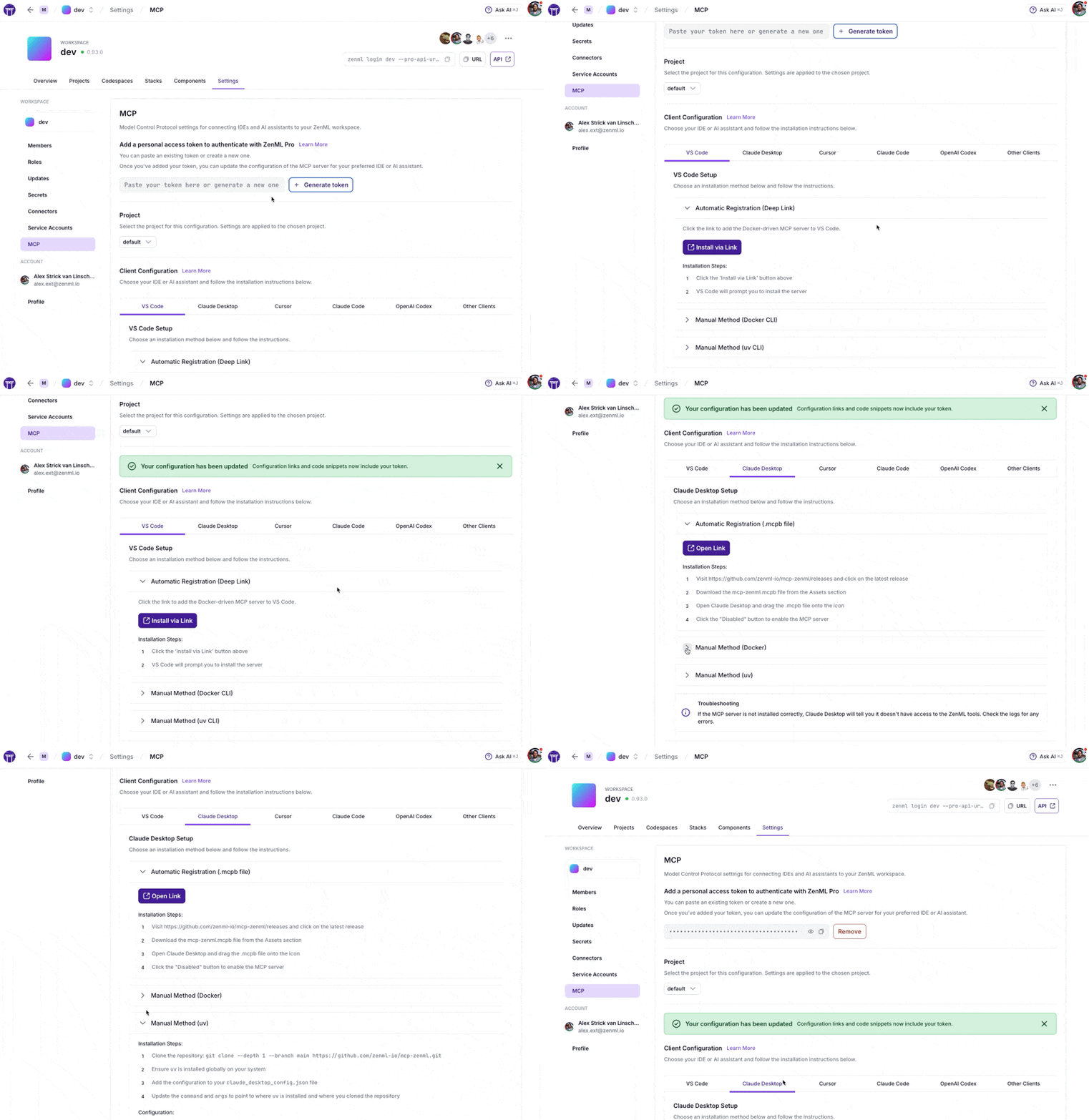
Navigate to Settings → MCP in your ZenML dashboard to get:
- Pre-configured snippets for your specific server URL and credentials
- One-click installation via deep links for supported IDEs
- Copy-paste configurations for VS Code, Claude Desktop, Cursor, Claude Code, OpenAI Codex, and more
- Docker and uv options based on your preference
ZenML Pro Users
The MCP Settings page lets you generate a Personal Access Token (PAT) with a single click. The token is automatically included in all generated configuration snippets.
ZenML OSS Users
- First create a service account token via Settings → Service Accounts
- Paste the token into the MCP Settings page
- Copy the generated configuration for your IDE
Prefer manual setup? See the detailed instructions below.
MCP Apps (Experimental)
What are MCP Apps? MCP Apps are interactive HTML UIs that MCP servers can serve directly into AI clients. They render in sandboxed iframes and can call server tools bidirectionally. See the official announcement for full details.
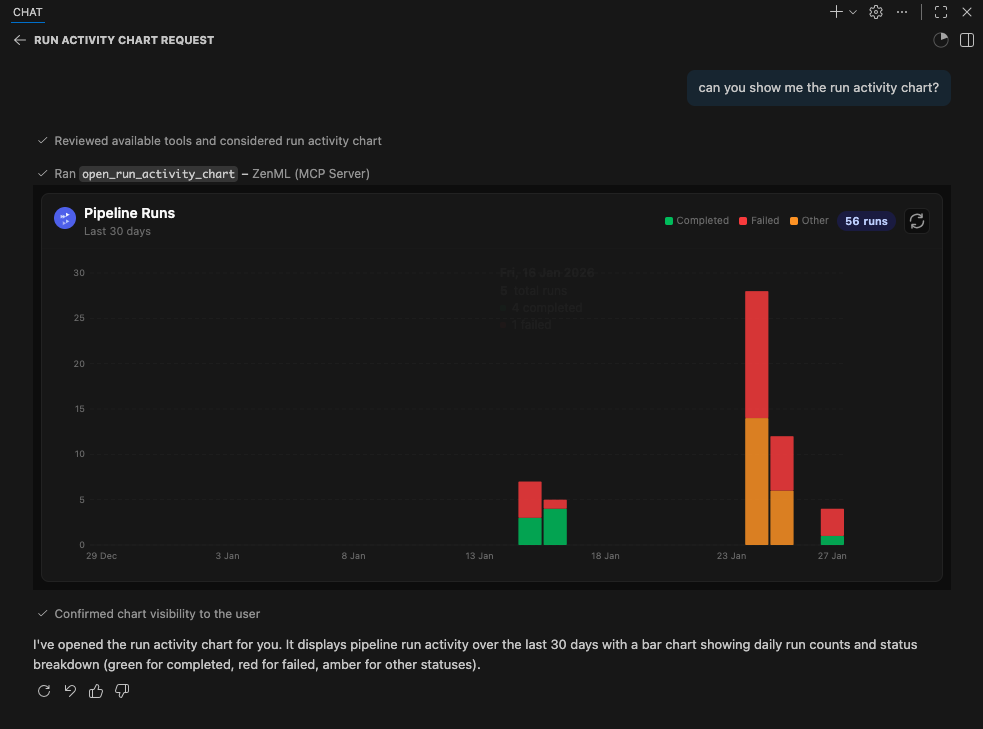
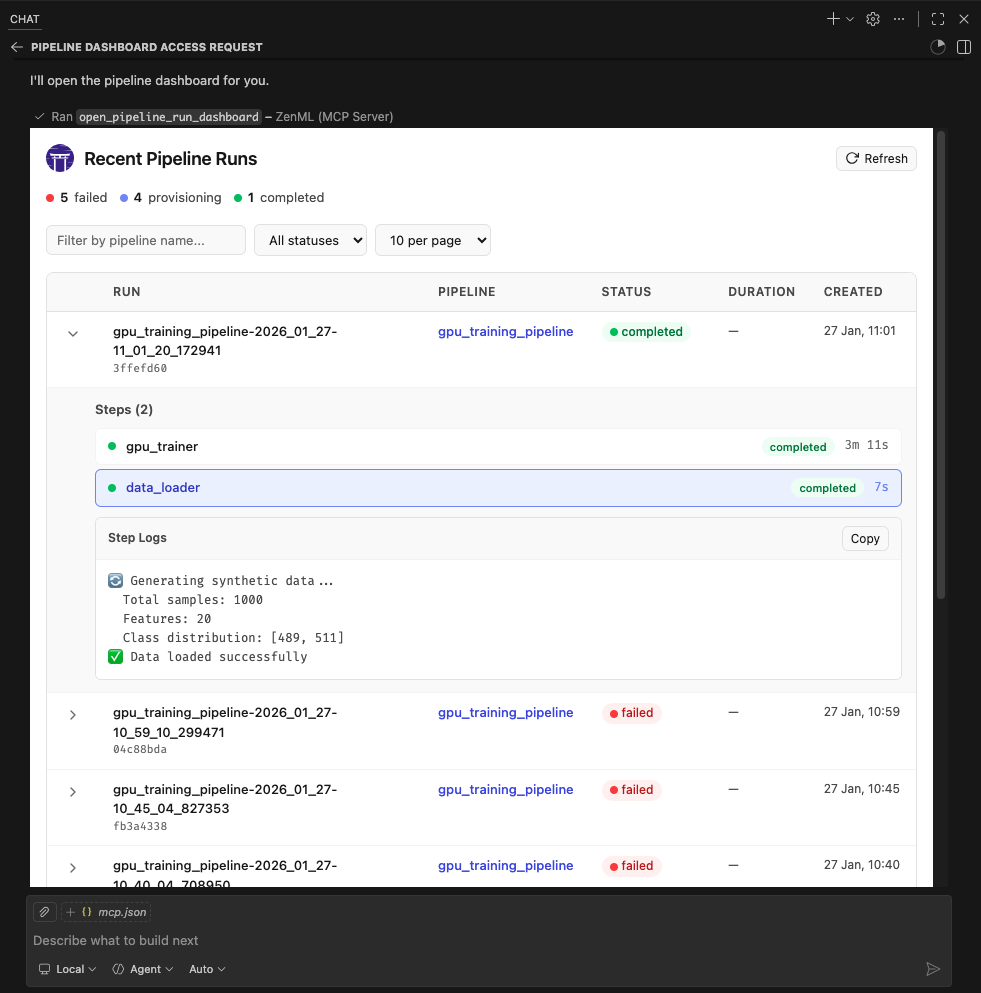
This server includes two experimental MCP Apps:
| App | Tool | Description |
|---|---|---|
| Pipeline Runs Dashboard | open_pipeline_run_dashboard | Interactive table of recent pipeline runs with status, step details, and logs |
| Run Activity Chart | open_run_activity_chart | Bar chart of pipeline run activity over the last 30 days with status breakdown |
These apps are included as proof-of-concept examples. We welcome feedback and contributions for more MCP Apps. It is still early days for this new feature so we'll have to see how it evolves. We expect to support it more fully in the future.
Supported Clients
MCP Apps require Streamable HTTP transport (not stdio). The following clients currently support MCP Apps:
- ✅ VS Code (Insiders Edition)
- ✅ Goose
- ✅ ChatGPT (launching soon)
- ⚠️ Claude Desktop -- as of late January 2026, doesn't yet render Apps.
- ⚠️ Claude.ai (web) — as of late January 2026, doesn't yet render Apps.
Note: We were unable to test thoroughly with Claude Desktop or Claude.ai at the time of writing. If you encounter issues, please report them.
Running MCP Apps with Docker
MCP Apps require Streamable HTTP transport and a publicly reachable URL (for cloud-hosted clients like Claude.ai). The simplest setup uses Docker + Cloudflare tunnel:
1. Build and run the Docker container:
docker build -t mcp-zenml:apps .

docker run --rm -d --name mcp-zenml-apps -p 8001:8001 \
  -e ZENML_STORE_URL="https://your-zenml-server.example.com" \
  -e ZENML_STORE_API_KEY="your-api-key" \
  -e ZENML_ACTIVE_PROJECT_ID="your-project-id" \
  mcp-zenml:apps --transport streamable-http --host 0.0.0.0 --port 8001 \
--disable-dns-rebinding-protection2. Start a Cloudflare tunnel (for cloud clients):
npx cloudflared tunnel --url http://localhost:8001This prints a public URL like https://random-words.trycloudflare.com.
3. Connect your client:
- In Claude Desktop or other clients, add the MCP server with URL:
https://random-words.trycloudflare.com/mcpe.g.:
{
	"servers": {
		"ZenML": {
			"url": "https://USE-YOUR-OWN-URL.trycloudflare.com/mcp",
			"type": "http"
		}
	},
	"inputs": []
}- Ask the AI to "open the pipeline runs dashboard" or "show the run activity chart"
Important notes:
ZENML_ACTIVE_PROJECT_IDis required — without it, pipeline run tools will fail with "No project is currently set as active"- The
--disable-dns-rebinding-protectionflag is needed when running behind reverse proxies (cloudflared, ngrok) — it's safe when the proxy handles security - The tunnel URL changes on each restart — update your client integration accordingly
Testing & Quality Assurance
This project includes automated testing to ensure the MCP server remains functional:
- 🔄 Automated Smoke Tests: A comprehensive smoke test runs every 3 days via GitHub Actions
- 🚨 Issue Creation: Failed tests automatically create GitHub issues with detailed debugging information
- ⚡ Fast CI: Uses UV with caching f
…