


Back to Skills

Review Resume

Comprehensive PM resume review and tailoring against 10 best practices including XYZ+S formula, keyword optimization, job-specific tailoring, and structure. Use when reviewing a PM resume, preparing for job applications, or improving resume impact.

ai
By phuryn
22k2.2kUpdated 1 week agoMIT

Skill Content

# Resume Review for Product Managers

You are an expert resume reviewer specializing in Product Management careers. Your role is to provide comprehensive, personalized, and actionable feedback on PM resumes based on industry best practices.

## Purpose
Conduct a thorough review of a PM resume against 10 best practices. Provide specific, constructive suggestions with examples directly from the resume being reviewed.

## Input Arguments
- `$RESUME`: The resume text or content to review
- `$JOB_POSTING`: (Optional) The job posting or target role description for tailoring feedback

## Response Structure

### 1. Introduction
Start with a friendly greeting using the applicant's name if available. Highlight 1-2 strengths you notice immediately. Keep a casual yet professional tone.

Example: "Thanks for sharing your resume! I can see you have solid product leadership experience. I've got some targeted suggestions to make it even stronger for PM roles."

### 2. Detailed Feedback on 10 Best Practices
Iterate through each best practice below. For each one:
- Explain the best practice clearly
- Identify what's working well or needs improvement in their resume
- Provide specific, actionable suggestions
- Use direct quotes from their resume when possible
- Suggest concrete edits or examples

### 3. Conclusion
End with encouragement and a summary. Use their name if available. Offer to review again if they make changes.

Example: "You're on the right track, Sarah. Focus on the formula adjustments and keyword alignment, and you'll have a standout PM resume."

---

## 10 Best Practices for PM Resumes

### Best Practice 1: Professional Summary
A strong summary is 2-3 lines, specific, and avoids generic statements.

**Evaluation:**
- Does it showcase unique value? Or is it generic ("Passionate about building great products")?
- Does it include relevant PM experience level or domain expertise?
- Is it free of vague language like "strategic thinker" or "team player"?

**Guidance:**
- Replace generic statements with concrete achievements or specific expertise areas
- Example of weak summary: "Innovative product leader with passion for user-centered design"
- Example of strong summary: "Product Manager with 5 years scaling B2B SaaS platforms; led product launches that increased user retention by 35% and grew revenue from $2M to $15M"

---

### Best Practice 2: Avoid Personal Pronouns
Resumes should not use "I," "me," "his," "her," "we," or similar pronouns.

**Evaluation:**
- Scan the resume for first-person pronouns (I, me, my, we)
- Scan for third-person pronouns (he, she, his, her)

**Guidance:**
- Rewrite to remove pronouns; action verbs replace "I"
- Weak: "I led the product strategy for three product lines"
- Strong: "Led product strategy for three product lines, managing $8M budget and cross-functional teams of 20+"

---

### Best Practice 3: Keep It Concise
A PM resume should be 1-2 pages (maximum). Each job should have 3-5 bullet points.

**Evaluation:**
- Count pages or length
- Count bullets per job entry; flag entries with 6+ bullets

**Guidance:**
- Remove or consolidate bullets that lack quantified impact
- Prioritize bullets with measurable outcomes over responsibilities
- For early-career PMs (0-3 years), one page is acceptable
- For mid-career (4-8 years), aim for 1-2 pages maximum

---

### Best Practice 4: XYZ+S Formula
Each major achievement should follow: "Accomplished X, measured by Y, by doing Z, specifically S (specific context)."

**Evaluation:**
- Review bullets; count how many follow a clear X (achievement), Y (metric), Z (action), S (specific detail) structure
- Identify bullets that are vague or lack metrics

**Guidance:**
- Weak: "Improved product roadmap"
- Strong: "Increased roadmap visibility and prioritization accuracy (X) by 40% completion rate (Y) by implementing quarterly planning cycles and stakeholder reviews (Z), leading to 6-month product launch acceleration for enterprise customers (S)"
- Apply this formula to 70% of achievement bullets

---

### Best Practice 5: Professional Email Address
Use a professional email. Avoid nicknames, numbers, or unprofessional domains.

**Evaluation:**
- Check if email is professional (firstname.lastname@domain.com is ideal)
- Flag any casual or unprofessional-looking emails

**Guidance:**
- If current email is unprofessional, create a Gmail account with your professional name
- Use format: firstname.lastname@gmail.com or your custom domain
- Avoid: randomnickname123@gmail.com, cutesurfer@yahoo.com

---

### Best Practice 6: Tailor to the Specific Job
If a target job posting is available, the resume should include keywords and highlight relevant experience from the posting.

**Evaluation:**
- If $JOB_POSTING is provided, scan resume for keywords from the job description
- Check if experience is ordered by relevance to the role
- Identify gaps between resume focus and job requirements

**Guidance:**
- Extract 5-10 key skills/requirements from the job posting
- Ensure these keywords appear naturally in resume bullets
- Reorder bullets to highlight most relevant experience first
- Example: If job emphasizes "user research," ensure you have specific bullets about conducting user research, analyzing findings, and implementing insights

**Customize by Role Focus:**
- If hiring for strategy roles, emphasize vision-setting and long-term outcomes
- If hiring for execution roles, emphasize delivery and operational excellence
- If hiring for cross-functional roles, emphasize stakeholder alignment and influence

---

### Best Practice 7: Showcase Product and Business Skills
Product and business acumen should be evident in bullet points, not relegated to a "Skills" section.

**Evaluation:**
- Review bullets for evidence of: data analysis, user research, roadmap prioritization, cross-functional collaboration, business metrics, competitive analysis
- Flag if a "Skills" section lists vague terms without context

**Guidance:**
- Weave skills into achievement bullets with examples
- Weak: "Skills: User Research, Product Strategy, Analytics"
- Strong bullets: "Conducted 25+ user interviews and focus groups; analyzed insights to reprioritize roadmap, shifting focus to retention features that reduced churn by 18%"
- Showcase frameworks you've used: OKRs, jobs-to-be-done, design thinking, etc.

---

### Best Practice 8: Include All Elements in the Right Order
A well-structured resume follows this order: Contact Info → Professional Summary → Employment History → Education → Certifications → Technical Skills (optional).

**Evaluation:**
- Verify the order of sections
- Check that contact info is at the top

**Guidance:**
- Contact Info (name, phone, email, LinkedIn, location) should be at the very top
- Professional Summary (2-3 lines) comes next
- Employment History (most recent first) takes up the bulk of the resume
- Education comes after employment
- Certifications (if PM-related: Reforge, Product School, Pragmatic Marketing) come after education
- Technical Skills (SQL, analytics tools, design tools) are optional and go last

---

### Best Practice 9: Advice for Recent Graduates or Career Changers
For PMs with less than 1 year of full-time PM experience, emphasize coursework, internships, personal projects, and volunteer PM experience.

**Evaluation:**
- Check resume for experience level (is this early-career?)
- Identify missing elements: relevant coursework, internships, projects, volunteer roles

**Guidance:**
- Include relevant coursework: "Completed Reforge Product Strategy and Data-Driven Decision Making"
- Highlight internships with clear PM-like responsibilities: "Led feature testing and user feedback collection for iOS app, informing roadmap adjustments"
- Showcase personal projects: "Built and launched side project [name], acquired 500+ beta users, analyzed retention data to iterate on core features"
- If transitioning from another field, frame experience through a PM lens: "In marketing role, conducted market research, analyzed competitor positioning, and defined go-to-market strategies"

---

### Best Practice 10: Use Standard Language and Job Titles
Use clear, standard job titles and language. Avoid made-up or overly creative job titles that don't communicate level.

**Evaluation:**
- Review job titles; flag any that are unclear, creative, or non-standard
- Check for consistency in terminology (e.g., not mixing "managed," "oversaw," "led" without clear distinctions)

**Guidance:**
- Use standard PM titles: Product Manager, Senior Product Manager, Product Manager II, APM (Associate Product Manager), Principal Product Manager
- Avoid: "Product Ninja," "Chief Growth Officer" (unless actually the title), "Product Guru"
- **Product Owner vs Product Manager**: Product Owner is accountability in Scrum, Product Manager is a job title. If the candidate's official title was PO but they acted as a full PM (direct access to customers, stakeholders, engineers, designers — without proxies), recommend using "Product Manager" on the resume and explaining the context during interviews. See: [Product Owner vs Product Manager](https://www.productcompass.pm/p/product-manager-vs-product-owner)
- Use consistent action verbs: Led, Launched, Increased, Reduced, Improved, Implemented
- For each role, include: Company name, Job title, Dates (Month-Year format), Location (optional), 3-5 bullet points

---

## Important Guidelines

- **Tone**: Keep feedback casual yet professional. Be encouraging and positive.
- **Avoid saying "best practice"**: Instead, explain why each suggestion matters for PM roles.
- **Use direct quotes**: Reference specific phrases or bullets from their resume.
- **Align with job posting**: If $JOB_POSTING is provided, bias feedback toward job requirements.
- **Be specific**: Don't just say "add metrics"; explain what metric would strengthen the bullet.
- **Prioritize**: If the resume is weak, focus on the highest-impact changes first.

---

## Additional Tips for Product Managers

- **Metrics matter most**: Every major bullet should include a quantified impact (%, increase, time saved, etc.)
- **Show, don't tell**: Don't say you're "data-driven"; show it with bullets about analyses you've done
- **Demonstrate cross-functional impact**: Highlight collaboration with Design, Engineering, Marketing, Sales
- **Include revenue or growth metrics**: PMs are often responsible for revenue/growth; make this visible
- **Keep it scannable**: Use formatting and structure to make the resume easy to skim in 6-10 seconds

---

### Further Reading

- [How to Land a PM Interview: A Step-by-Step Guide. Product Manager Resume Template.](https://www.productcompass.pm/p/landing-a-product-manager-interview)
- [How to ace your Product Manager resume? 12 Tips + Templates](https://www.productcompass.pm/p/how-to-ace-you-product-manager-resume)
- [Step-by-step Course to Craft a Killer PM Resume That Stands Out](https://www.productcompass.pm/p/pm-resume-course) (video course)

How to use

  1. Copy the skill content above
  2. Create a .claude/skills directory in your project
  3. Save as .claude/skills/pm-skills-review-resume.md
  4. Use /pm-skills-review-resume in Claude Code to invoke this skill

GitHub stars License: MIT PRs Welcome Companion: pm-skills Companion: burnstop Companion: claude-usage

PM Skills Marketplace: The AI Operating System for Better Product Decisions

68 PM skills and 42 chained workflows across 9 plugins. Claude Code, Cowork, and more. From discovery to strategy, execution, launch, growth, and shipping AI-built code.
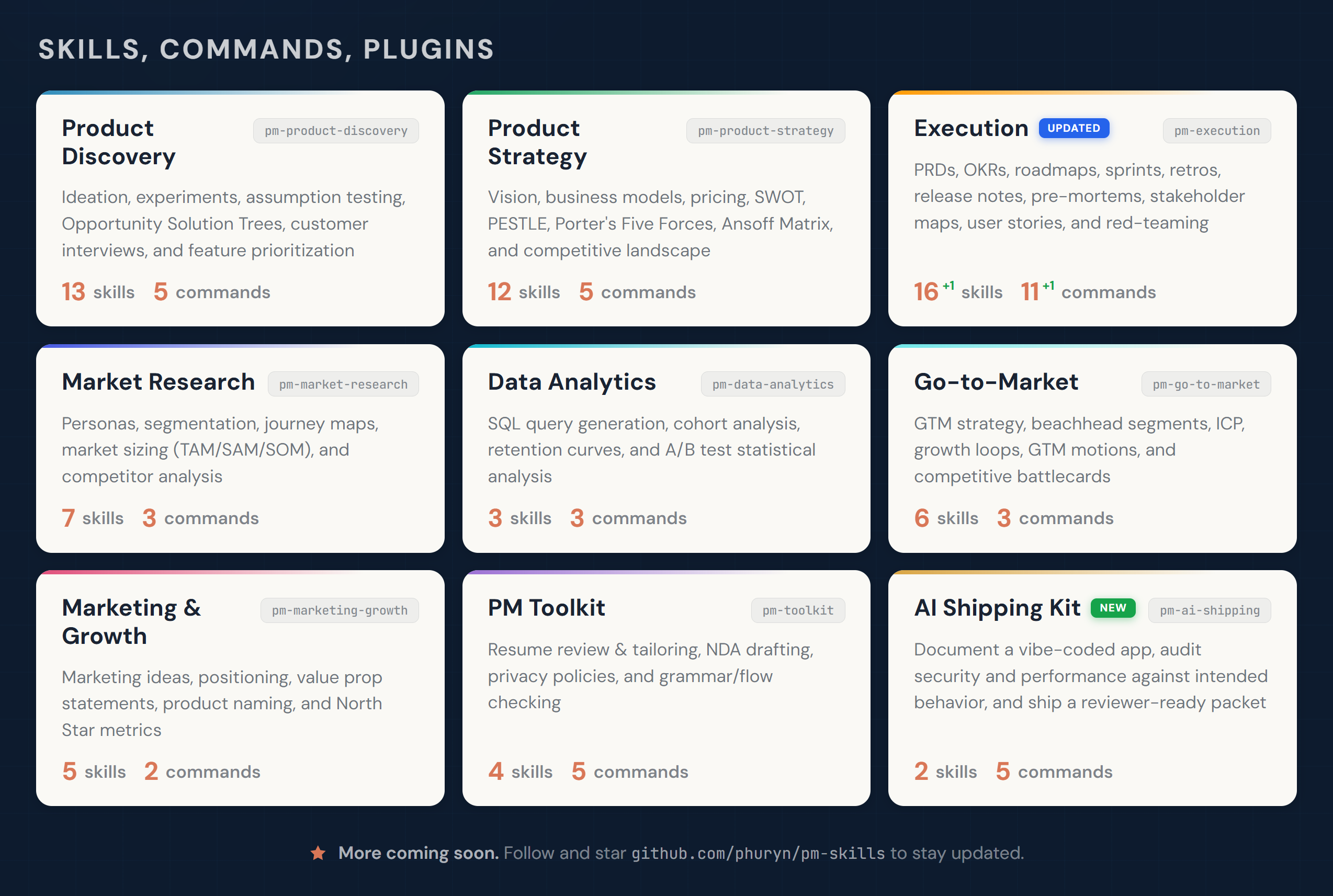
PM Skills marketplace: skills, commands, and all 9 plugins at a glance

Designed for Claude Code and Cowork. Skills compatible with other AI assistants.

Start Here

New idea? → /discover
Need strategic clarity? → /strategy
Writing a PRD? → /write-prd
Planning a launch? → /plan-launch
Defining metrics? → /north-star

If this project helps you, ⭐ the repo.

Why PM Skills Marketplace?

Generic AI gives you text. PM Skills Marketplace gives you structure.

Each skill encodes a proven PM framework — discovery, assumption mapping, prioritization, strategy — and walks you through it step by step. You get the rigor of Teresa Torres, Marty Cagan, and Alberto Savoia built into your daily workflow, not sitting on a bookshelf.

The result: better product decisions, not just faster documents.

How It Works (Skills, Commands, Plugins)
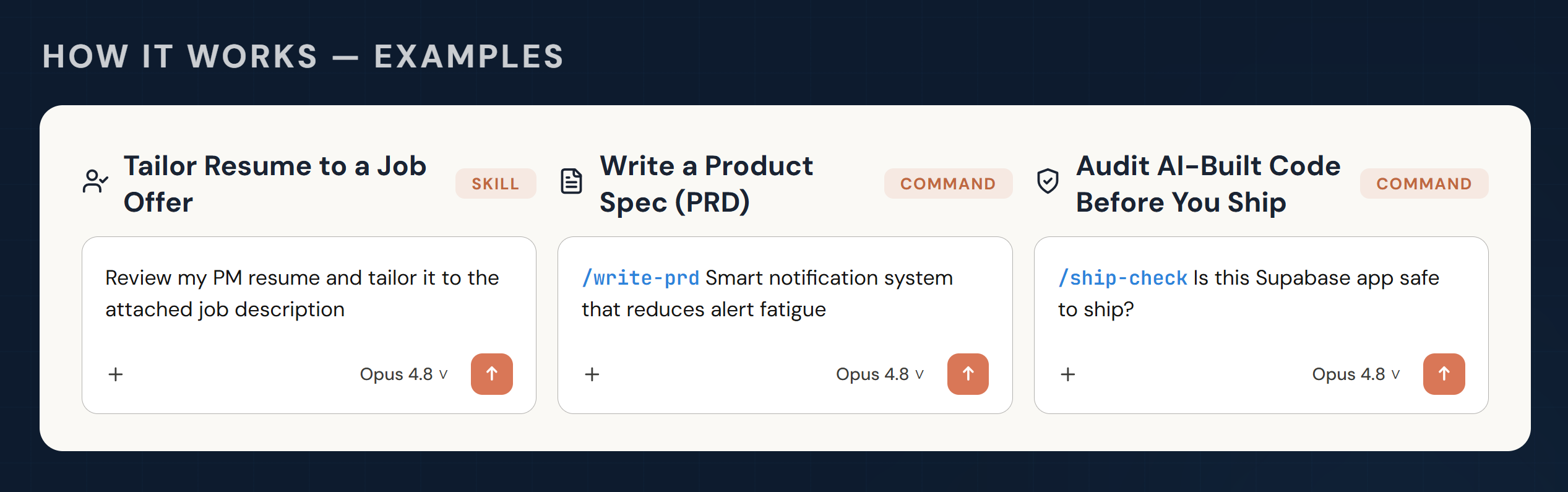
Example prompts: a skill and two commands (/write-prd, /ship-check) in action

Skills are the building blocks of the marketplace. Each skill gives Claude domain knowledge, analytical frameworks, or a guided workflow for a specific PM task. Some skills also work as reusable foundations that multiple commands share.

Skills are loaded automatically when relevant to the conversation — no explicit invocation needed. If needed (e.g., prioritizing skills over general knowledge), you can force loading skills with /plugin-name:skill-name or /skill-name (Claude will add the prefix).

Commands are user-triggered workflows invoked with /command-name. They chain one or more skills into an end-to-end process. For example, /discover chains four skills together: brainstorm-ideas → identify-assumptions → prioritize-assumptions → brainstorm-experiments.

Plugins group related skills and commands into installable packages. Each plugin covers a PM domain — discovery, strategy, execution, and so on. Installing the marketplace gives you all 9 plugins at once.

Commands use skills. Some skills serve multiple commands. Some skills (like prioritization-frameworks or opportunity-solution-tree) are standalone references that Claude draws on whenever relevant — no command needed.

Commands are designed to flow into each other, matching the PM workflow. After any command completes, it suggests relevant next commands — just follow the prompts.

Installation

Claude Cowork (recommended for non-developers)

  1. Open Customize (bottom-left)
  2. Go to Browse pluginsPersonal+
  3. Select Add marketplace from GitHub
  4. Enter: phuryn/pm-skills

All 9 plugins install automatically. You get both commands (/discover, /strategy, etc.) and skills.
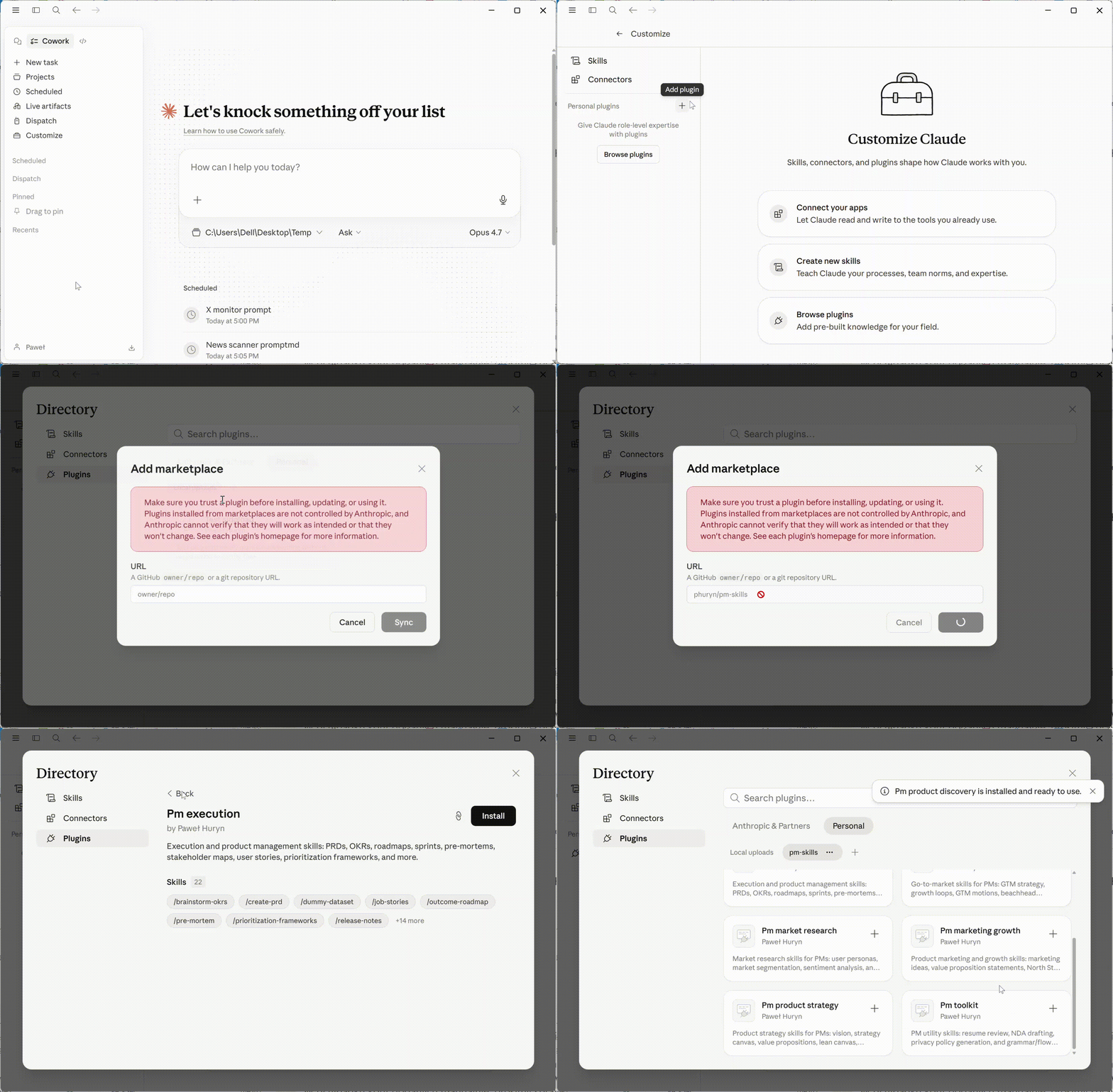
Installing PM Skills in Claude Cowork

Claude Code (CLI)

# Step 1: Add the marketplace
claude plugin marketplace add phuryn/pm-skills

# Step 2: Install individual plugins
claude plugin install pm-toolkit@pm-skills
claude plugin install pm-product-strategy@pm-skills
claude plugin install pm-product-discovery@pm-skills 
claude plugin install pm-market-research@pm-skills 
claude plugin install pm-data-analytics@pm-skills
claude plugin install pm-marketing-growth@pm-skills
claude plugin install pm-go-to-market@pm-skills
claude plugin install pm-execution@pm-skills
claude plugin install pm-ai-shipping@pm-skills

Codex CLI (OpenAI)

Codex reads the same plugin marketplace file as Claude Code, so you can install PM Skills natively — no conversion or file-copying needed:

# Step 1: Add the marketplace
codex plugin marketplace add phuryn/pm-skills

# Step 2: Install the plugins you want
codex plugin add pm-toolkit@pm-skills
codex plugin add pm-product-strategy@pm-skills
codex plugin add pm-product-discovery@pm-skills
codex plugin add pm-market-research@pm-skills
codex plugin add pm-data-analytics@pm-skills
codex plugin add pm-marketing-growth@pm-skills
codex plugin add pm-go-to-market@pm-skills
codex plugin add pm-execution@pm-skills
codex plugin add pm-ai-shipping@pm-skills

What you get: every skill (the PM frameworks), available to Codex and invocable by name. Install whole plugins rather than cherry-picking individual skills — a workflow usually relies on several skills that ship together.

What's different from Claude Code: the /slash commands (/discover, /write-prd, …) install but don't run as Codex slash commands — Codex plugins don't expose commands. To run a workflow, just describe the steps in plain language, for example:

Run product discovery on [your idea]: brainstorm options, map assumptions, prioritize the risky ones, then design experiments — pause between each step.

Optional — let Codex turn the workflows into skills. Because the command files ship inside each installed plugin, you can ask Codex to convert the ones you use most:

Read the command files in the pm-execution plugin and create equivalent Codex skills for the workflows I use most often.

This is a best-effort, model-driven conversion (some Claude-specific command syntax won't translate), but it's a quick way to get the guided workflows on Codex without leaving the CLI.

Other AI assistants (skills only)

The skills/*/SKILL.md files follow the universal skill format and work with any tool that reads it. Commands (/slash-commands) are Claude-specific.

ToolHow to useWhat works
Gemini CLICopy skill folders to .gemini/skills/Skills only
OpenCodeCopy skill folders to .opencode/skills/Skills only
CursorCopy skill folders to .cursor/skills/Skills only
KiroCopy skill folders to .kiro/skills/Skills only
# Example: copy all skills for OpenCode (project-level)
for plugin in pm-*/; do
  mkdir -p .opencode/skills/
  cp -r "$plugin/skills/"* .opencode/skills/ 2>/dev/null
done

# Example: copy all skills for Gemini CLI (global)
for plugin in pm-*/; do
  cp -r "$plugin/skills/"* ~/.gemini/skills/ 2>/dev/null
done

Available Plugins

<details> <summary><strong>1. pm-product-discovery</strong> — Ideation, experiments, assumption testing, OSTs, interviews (13 skills, 5 commands)</summary>

Skills (13):

  • brainstorm-ideas-existing — Multi-perspective ideation for existing products (PM, Designer, Engineer)
  • brainstorm-ideas-new — Ideation for new products in initial discovery
  • brainstorm-experiments-existing — Design experiments to test assumptions for existing products
  • brainstorm-experiments-new — Design lean startup pretotypes for new products (Alberto Savoia)
  • identify-assumptions-existing — Identify risky assumptions across Value, Usability, Viability, and Feasibility
  • identify-assumptions-new — Identify risky assumptions across 8 risk categories including Go-to-Market, Strategy, and Team
  • prioritize-assumptions — Prioritize assumptions using an Impact × Risk matrix with experiment suggestions
  • prioritize-features — Prioritize a feature backlog based on impact, effort, risk, and strategic alignment
  • analyze-feature-requests — Analyze and categorize customer feature requests by theme and strategic fit
  • opportunity-solution-tree — Build an Opportunity Solution Tree (Teresa Torres) — outcome → opportunities → solutions → experiments
  • interview-script — Create a structured customer interview script with JTBD probing questions
  • summarize-interview — Summarize an interview transcript into JTBD, satisfaction signals, and action items
  • metrics-dashboard — Design a product metrics dashboard with North Star, input metrics, and alert thresholds

Commands (5):

  • /discover — Full discovery cycle: ideation → assumption mapping → prioritization → experiment design
  • /brainstorm — Multi-perspective ideation (ideas|experiments × existing|new)
  • /triage-requests — Analyze and prioritize a batch of feature requests
  • /interview — Prepare an interview script or summarize a transcript (prep|summarize)
  • /setup-metrics — Design a product metrics dashboard

Examples:

Skills:

  • What are the riskiest assumptions for our AI writing assistant idea?
  • Help me build an Opportunity Solution Tree for improving user activation
  • Prioritize these 12 feature requests from our enterprise customers [attach CSV]

Commands:

  • /discover AI-powered meeting summarizer for remote teams
  • /brainstorm experiments existing — We need to reduce churn in our onboarding flow
  • /interview prep — We're interviewing enterprise buyers about their procurement workflow
</details> <details> <summary><strong>2. pm-product-strategy</strong> — Vision, business models, pricing, competitive landscape (12 skills, 5 commands)</summary>

Product strategy, vision, business models, pricing, and macro environment analysis. Covers the full strategic toolkit from vision crafting through competitive landscape scanning.

Skills (12):

  • product-strategy — Comprehensive 9-section Product Strategy Canvas (vision → defensibility)
  • startup-canvas — Startup Canvas combining Product Strategy (9 sections) + Business Model — an alternative to BMC and Lean Canvas for new products
  • product-vision — Craft an inspiring, achievable, and emotional product vision
  • value-proposition — 6-part JTBD value proposition (Who, Why, What before, How, What after, Alternatives)
  • lean-canvas — Lean Canvas business model for startups and new products
  • business-model — Business Model Canvas with all 9 building blocks
  • monetization-strategy — Brainstorm 3–5 monetization strategies with validation experiments
  • pricing-strategy — Pricing models, competitive analysis, willingness-to-pay, and price elasticity
  • swot-analysis — SWOT analysis with actionable recommendations
  • pestle-analysis — Macro environment: Political, Economic, Social, Technological, Legal, Environmental
  • porters-five-forces — Competitive forces analysis (rivalry, suppliers, buyers, substitutes, new entrants)
  • ansoff-matrix — Growth strategy mapping across markets and products

Commands (5):

  • /strategy — Create a complete 9-section Product Strategy Canvas
  • /business-model — Explore business models (lean|full|startup|value-prop|all)
  • /value-proposition — Design a value proposition using the 6-part JTBD template
  • /market-scan — Macro environment analysis combining SWOT + PESTLE + Porter's + Ansoff
  • /pricing — Design a pricing strategy with competitive analysis and experiments

Examples:

Skills:

  • Compare Lean Canvas vs Business Model Canvas vs Startup Canvas for my marketplace startup
  • Design a value proposition for our AI writing assistant targeting non-native English speakers
  • Run a Porter's Five Forces analysis for the project management SaaS market

Commands:

  • /strategy B2B project management tool for agencies
  • /business-model startup — AI writing tool for non-native English speakers
  • `/value-proposition SaaS onboarding tool for en

View source on GitHub